
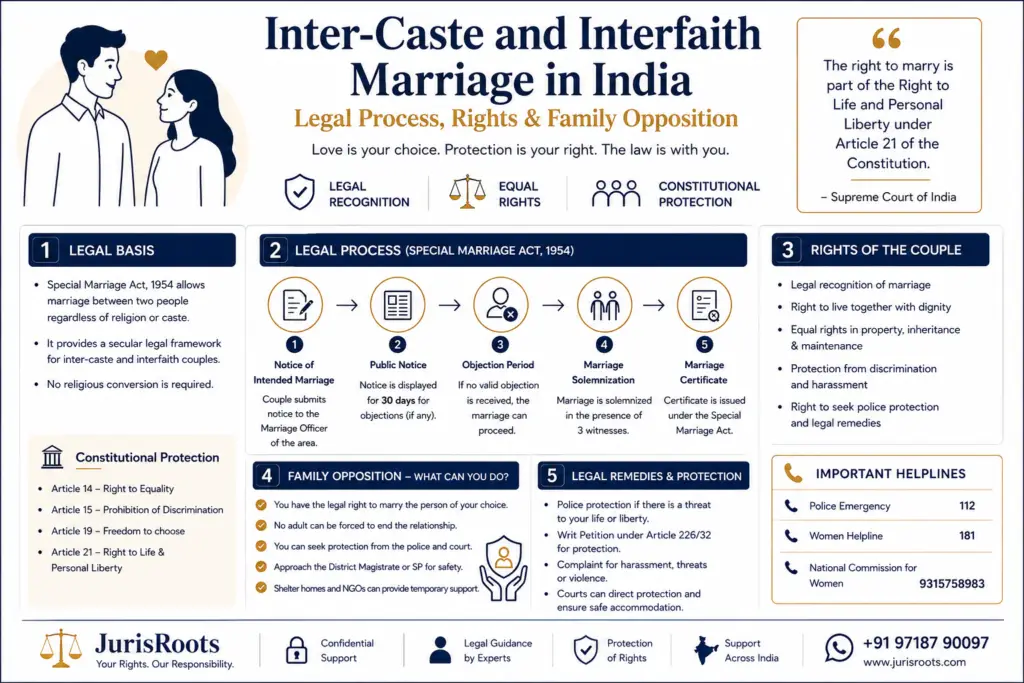
Inter-Caste and Interfaith Marriage in India: Legal Process, Rights & Family Opposition
Marrying outside your caste or religion is completely legal in India, but couples in this situation often face a different set of practical hurdles than a typical court marriage — family opposition, delayed consent, and confusion over which law actually applies. This guide explains the legal route, the rights you already have, and how to protect yourselves if a family objects.
Which law applies: Special Marriage Act vs personal law
Most inter-caste and interfaith couples register under the Special Marriage Act, 1954, because it does not require either partner to convert or follow the other’s religious rites. It is a purely civil registration that any two adults — regardless of caste, religion, or community — can use. Couples who prefer a religious ceremony first (for example, an Arya Samaj wedding) can still register the marriage afterward, but the Special Marriage Act route is usually simpler when families are not fully on board, since it does not depend on either side’s religious institution recognising the union.
The 30-day notice period, explained
Under the Special Marriage Act, a Notice of Intended Marriage must be filed at the Marriage Officer’s office and is displayed publicly for 30 days, during which anyone can raise an objection. This step exists to prevent fraud and bigamy, not to give families a veto — but in practice it is also the point where opposition surfaces. If no valid legal objection (such as an existing marriage or a minor applicant) is raised, the marriage can be solemnised once the notice period ends, and the officer cannot refuse it on grounds of caste or religion alone.
Do you need parental consent?
No. Once both partners are adults — 21 or above for men and 18 or above for women under current law — parental or family consent is not legally required for marriage or registration. Marriage officers and courts have repeatedly upheld this, including in cases involving inter-caste and interfaith couples. Family disapproval, however strongly expressed, does not give anyone the legal authority to stop a marriage between consenting adults or to compel its annulment afterward.
What to do if a family threatens or opposes the marriage
If you anticipate or are already facing threats, harassment, or attempts to forcibly separate you, courts allow adult couples to file a joint petition for protection, typically directed at the local police, which requires them to ensure your safety. Keep a written record of any threats, and inform the Marriage Officer’s office in writing if you expect an objection to be raised during the notice period so it can be handled formally rather than informally. An advocate can also advise on whether a protection petition should be filed before or after the marriage notice, depending on the situation.
Documents you will typically need
Both partners will need proof of age and identity, proof of current residence to establish which Marriage Officer has jurisdiction, recent photographs, and a signed declaration of marital status. If either partner has been married before, the relevant divorce decree or death certificate of the former spouse is required. Where a religious ceremony has already taken place, its invitation card or photographs can support the application but are not mandatory for a Special Marriage Act registration.
NRI and overseas partners
Interfaith and inter-caste couples where one partner lives abroad follow largely the same process, with additional verification of the NRI partner’s documents and, in some cases, a longer notice period depending on the jurisdiction. It is worth confirming embassy or consulate requirements early, since document attestation can take longer than the marriage registration itself.
Why proper legal guidance matters here
Inter-caste and interfaith cases are more likely to encounter procedural objections, delayed hearings, or attempts to misuse the 30-day notice period than straightforward court marriages. Having an advocate manage the notice filing, respond to objections, and coordinate with the Sub-Registrar or District Court office reduces the chance of avoidable delay and gives you a documented legal position if family opposition escalates.
JurisRoots assists inter-caste, interfaith, and NRI couples across Delhi, Noida, Greater Noida, Ghaziabad, Gurugram, and Faridabad with end-to-end court marriage and registration support, including guidance on legal protection when family opposition is a concern. Every case is handled directly by Bar Council-enrolled advocates, with confidential, fixed-fee consultations available online.